Risk adjustment is a complex but critically important topic for the Medicare, Medicaid, and Affordable Care Act (ACA) Exchange markets. In this listicle, we highlight six key pieces of information that every life sciences company should understand about risk adjustment.
1. Risk adjustment is a mechanism to quantify the morbidity of a plan’s beneficiaries relative to the rest of the market based on their health conditions and demographics.1
Risk-adjustment models assign a risk score to each beneficiary, which then rolls up to a plan or rate cell-level risk score. Higher risk scores suggest that the plan’s beneficiaries have higher acuity than the rest of the market, whereas lower risk scores indicate the plan’s beneficiaries have lower acuity than the rest of the market. The objective of risk adjustment is to ensure that plans are compensated appropriately for the risk they manage while reducing incentives to attract only healthy beneficiaries.
2. Risk adjustment directly impacts health plan revenue.
In Medicare Advantage, CMS risk-adjusts both Part D direct subsidy payments and Part C benchmark payments. Similarly, Medicaid capitation payments from states to plans are risk adjusted. In the ACA Exchange, plans pay or receive a risk-adjustment transfer payment into a pool that sums to zero across all payers in a specific risk pool in the state.
3. Risk adjustment significantly impacts health plan profitability and, therefore, formulary coverage determinations.
Risk scores are calculated at the beneficiary level based on the conditions they have as well as their demographics. Conceptually, beneficiaries with higher-cost conditions have higher risk scores. Most often, risk scores are calculated using an additive model, such that beneficiaries with multiple conditions will receive risk scores that combine the impact of the coefficients of each one (generally, the sum of the condition coefficients, demographic coefficients, and any interaction terms). Because it impacts revenue, the variability of risk scores by beneficiary has meaningful implications to plan profitability.
Following is an example of a calculation for two similar products, assumed to be clinically interchangeable, in the Medicare Part D market that illustrates how risk adjustment can impact a plan’s bottom line. This example shows a comparison on plan financials for drugs at different price points. Drug A is a higher cost than Drug B, but patients taking Drug A have a higher average risk score than patients taking Drug B.
Figure 1: Impact of risk adjustment on plan financials
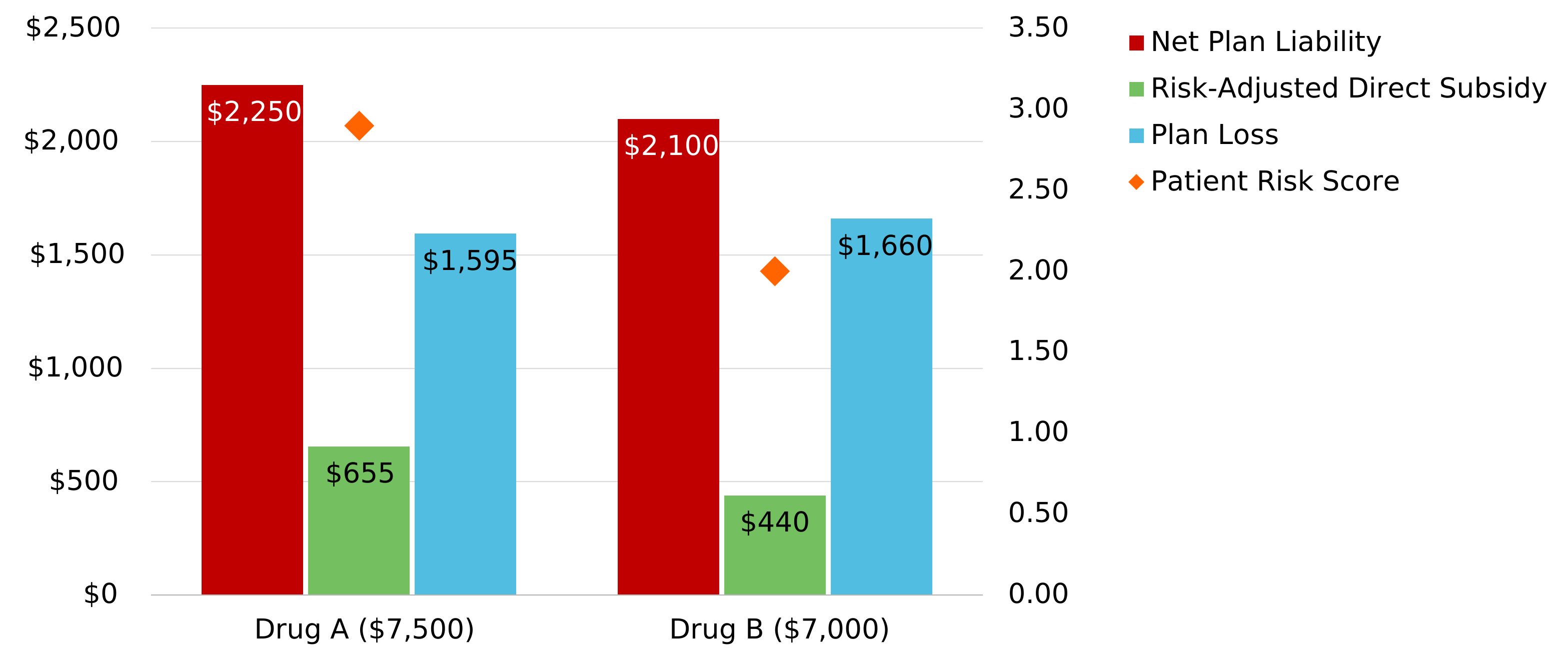
Assumes the plan pays 60% of gross drug cost (i.e., a catastrophic claim) and receives a 30% rebate. Plan rebates are reduced by 13% to reflect rebates on reinsurance. Risk-adjusted direct subsidy is calculated as [national average monthly bid amount (NAMBA) x risk score – national average member premium (NAMP)], where NAMBA and NAMP reflect the 2026 values of $239.47 and $38.99 respectively. Plan loss is calculated as risk-adjusted direct subsidy less net plan liability for drug, ignoring any premium and administrative expenses as those do not vary by drug.
In this case, it may appear that a plan would prefer Drug B because its net plan liability is lower than Drug A. However, after considering the risk-adjusted revenue received, the plan would actually prefer to cover Drug A over Drug B since the plan loss is lower for Drug A than Drug B. It is important for life sciences companies to understand the impact of risk adjustment to have a better understanding of how plans make formulary decisions.
4. There are practical constraints to CMS risk-adjustment models.
Like all predictive models, each risk-adjustment model is subject to functional limitations.
- Models are calibrated using lagged data. Since models are created prior to the applicable payment year, the underlying data is frequently at least two to three years old.2 This can have major implications when major market events, such as new drug launches or generic entries, occur between the calibration and payment periods. In some cases, explicit adjustments are made to address this. For example, CMS recently adjusted this by updating the 2025 Part D risk-adjustment model to reflect the Medicare Part D redesign.3
- Predictive accuracy tends to decrease at the extremes. Models are generally most accurate in predicting costs for the large majority of beneficiaries close to the average. However, predictive accuracy tends to be less accurate for the lowest and highest percentiles of beneficiaries, resulting in over- and underpayments to plans,4 respectively.
- Models do not account for variability in treatment costs. For example, a beneficiary would be assigned the same risk score if they are diagnosed with “diabetes without complications,” reflective of the average cost to treat the condition. If they are managing their condition with low-cost metformin or a higher-cost brand insulin, this can result in an over- or underpayment to the plan, relative to the condition average cost.
- Manufacturer rebates are not accounted for. Risk-adjustment models are calibrated based on gross plan costs, before rebates, although rebates reduce plan liability. One notable exception is the 2026 Medicare Part D model, which accounts for negotiated net prices from the Medicare Drug Price Negotiation Program, effectively incorporating rebates for those brands.
- Models are not intended to predict acute expenditures. Although acute events can represent major expenditures for plans, risk-adjustment models are primarily designed to predict cost based on chronic conditions.
5. Risk adjustment models vary by health plan market.5
For example, models differ in how risk scores are assigned. In the ACA Exchange, risk scores are assigned based on medical diagnoses and pharmacy utilization, whereas Medicare risk scores are only based on medical diagnoses for both Part C and Part D. The Medicaid market uses both methodologies, depending on the state. The commercial employer market is not subject to any state or federal risk adjustment at all, but may use private models such as Milliman Advanced Risk Adjusters (MARA)® for provider risk sharing, care management, or other purposes.6 There are many other differences between markets as well, including timing and payment application (i.e., zero sum vs. adjusting a payment).
6. Health plan risk-adjustment models are frequently updated.
The frequency of updates depends on the needs of each market to stay aligned with expected costs. Model coefficients are typically updated each year to account for changes in relative costs between conditions and other unique dynamics (e.g., the Medicare Drug Price Negotiation Program in Part D, historical adjustments to Hepatitis C coefficients). The Exchange model is typically updated several times per year to account for new and terminated national drug codes (NDCs), which may be used to identify conditions. More meaningful model overhauls, such as adding or removing conditions, typically only occur every several years.
Conclusion: Why life sciences companies should understand and monitor risk adjustment
Understanding and monitoring risk adjustment is essential for life sciences companies because it impacts how payers assess the financial impact of therapies, shapes formulary decisions, and affects patient access to treatments.7 By understanding risk-adjustment mechanisms and each one’s unique dynamics, life sciences companies can better position their products for favorable coverage and ensure more equitable access for patients.
1 Centers for Medicare & Medicaid Services. (n.d.). Risk adjustment. CMS.gov. Retrieved February 6, 2026, from https://www.cms.gov/priorities/innovation/key-concepts/risk-adjustment.
2 Centers for Medicare & Medicaid Services. (April 7, 2025). Announcement of calendar year (CY) 2026 Medicare Advantage (MA) capitation rates and Part C and Part D payment policies. CMS.gov. Retrieved February 6, 2026, from https://www.cms.gov/files/document/2026-announcement.pdf.
3 Klein, M., Petroske, J.J., & Rodrigues, D.I. (April 26, 2024). A prescription for change: How the 2025 Medicare Part D risk adjustment (RxHCC) model overhaul will affect risk scores. Milliman. Retrieved February 6, 2026, from https://www.milliman.com/en/insight/prescription-for-change-2025-medicare-part-d-risk-adjustment-model.
4 Centers for Medicare & Medicaid Services. (April 7, 2025). Announcement of calendar year (CY) 2026 Medicare Advantage (MA) capitation rates and Part C and Part D payment policies. CMS.gov. Retrieved February 6, 2026, from https://www.cms.gov/files/document/2026-announcement.pdf.
5 Sun, M., Afenir, D., & Barrington, A. (January 10, 2025). Risk adjustment: Methodologies for identifying uncaptured conditions. Milliman. Retrieved February 6, 2026, from https://www.milliman.com/en/insight/risk-adjustment-methodologies-uncaptured-conditions.
6 Milliman. (n.d.). Milliman Advanced Risk Adjusters. Retrieved February 6, 2026, from https://www.milliman.com/en/products/mara.
7 Carioto, J., Dieguez, G., & Makhija, T. (December 2023). Financial implications of the Inflation Reduction Act are expected to lead to a reassessment of formulary strategies by Part D plans. Milliman. Retrieved February 6, 2026, from https://www.milliman.com/en/insight/financial-implications-ira-formulary-strategies-part-d.