Many people may assume that their long-term care (LTC) needs will be fully covered by existing health insurance coverage or government programs but, in reality, coverage for LTC services is often limited and can be confusing. As a result, individuals often lack a clear understanding of what types of LTC services they might require, what coverage options exist and, crucially, how much they should plan to spend on these services.
We created the Milliman Long-Term Care Index (LTC Index) to provide a clear benchmark for expected lifetime LTC costs using illustrative commercial payment rates. With a record number of Americans—4.18 million—turning 65 in 2025, understanding the potential costs of LTC beyond age 65 is more important than ever as individuals, government programs, and insurance companies contend with LTC financing.
2025 LTC Index: The future lifetime cost of long-term care for a 65-year-old
LTC encompasses a range of services and supports to help individuals meet their personal care needs and complete daily tasks, such as assistance with bathing, dressing, eating, or moving around. Individuals may receive LTC at home, in a facility setting like a nursing home, or in a community-based setting like an assisted-living facility. LTC can be provided “formally” through paid services/caregivers or “informally” by family/loved ones.
Despite the prevalence of LTC needs, many individuals are unaware that Medicare provides very limited coverage for LTC, and, while Medicaid is the largest payer of LTC services, individuals rely on personal savings, LTC insurance, or other resources (such as unpaid care) before qualifying for Medicaid.
The Milliman LTC Index was created to help individuals and stakeholders understand expected costs. The LTC Index measures lifetime costs of formal paid LTC services for a 65-year-old in 2025 and accounts for the fact that not every person will require LTC. We assumed services would be covered at commercial market rates based on patterns of use observed in insurance data. For additional information on the data sources used to compile the index, please see the Sources and Assumptions section below.
The 2025 Milliman LTC Index is $135,000. This figure represents the projected average amount a 65-year-old would need to set aside today to cover average, expected future lifetime costs of LTC. The estimate assumes a 4.35% investment return rate and that services are paid at commercial market rates, meaning what an individual would pay out of pocket without reimbursement from Medicaid or other sources. The $135,000 in lifetime costs reflects a composite across projected costs of $171,000 for females and $98,000 for males.
Figure 1: Projected LTC costs over the remaining lifetime of a 65-year-old in 2025

Why are projected long-term care costs higher for females than for males?
The LTC Index is approximately 75% higher for females than for males, as illustrated in Figure 1. Several factors contribute to this difference.
- Greater likelihood of requiring paid LTC: Females are generally more likely than males to need formal paid LTC in any given year.
- Greater life expectancy: Females generally live longer than males, which increases the number of years during which they may need LTC.
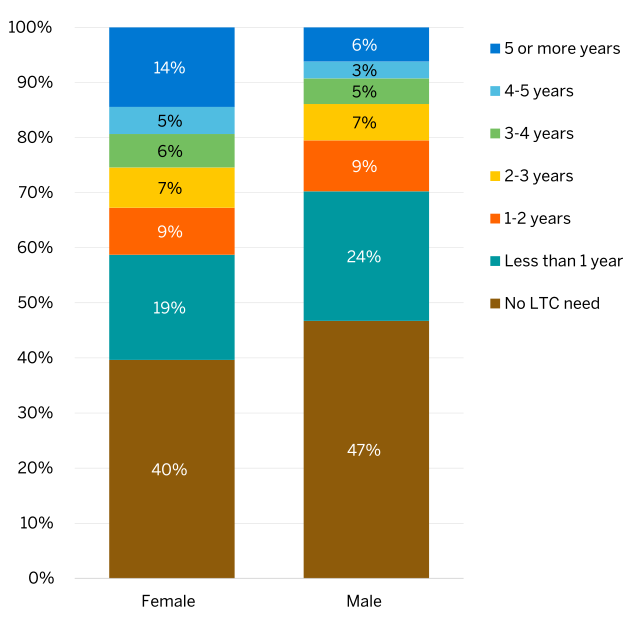
- Longer duration of need: Because women generally live longer than men, they are more likely to require LTC for longer periods. Figure 2 illustrates the distribution of LTC need for males and females, highlighting that a greater proportion of females need care for extended durations. For example, 14% of females require paid LTC for five or more years, compared to only 6% of males who need care for this length of time.
Figure 2: Projected distribution of LTC need
How do long-term care costs vary depending on how long care is needed?
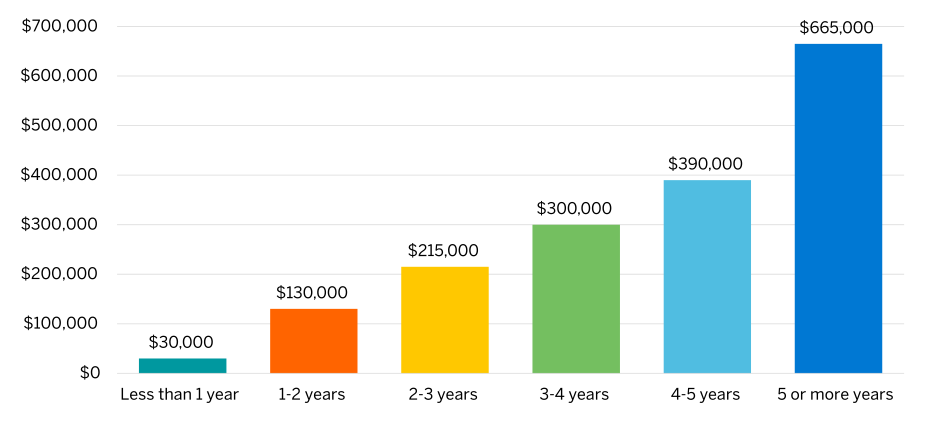
While the 2025 Milliman LTC Index estimates average LTC costs of $135,000, this value reflects a wide range of care durations and associated expenses. In practice, the total cost of LTC depends heavily on how long care is needed. For example, approximately half of all individuals who require LTC will need care for less than one year.
Figure 3 illustrates how costs can vary significantly depending on how long care is needed. Shorter durations of need are associated with much lower costs, with average total costs estimated at around $30,000, while individuals requiring care for five years or more experience costs exceeding $665,000 on average. Extended care needs place significant financial strain on individuals, caregivers, and programs that provide coverage for LTC.
Figure 3: LTC index by length of need
How do long-term care costs vary by location?
LTC costs can vary significantly depending on location. Several factors influence these variations, including the following.
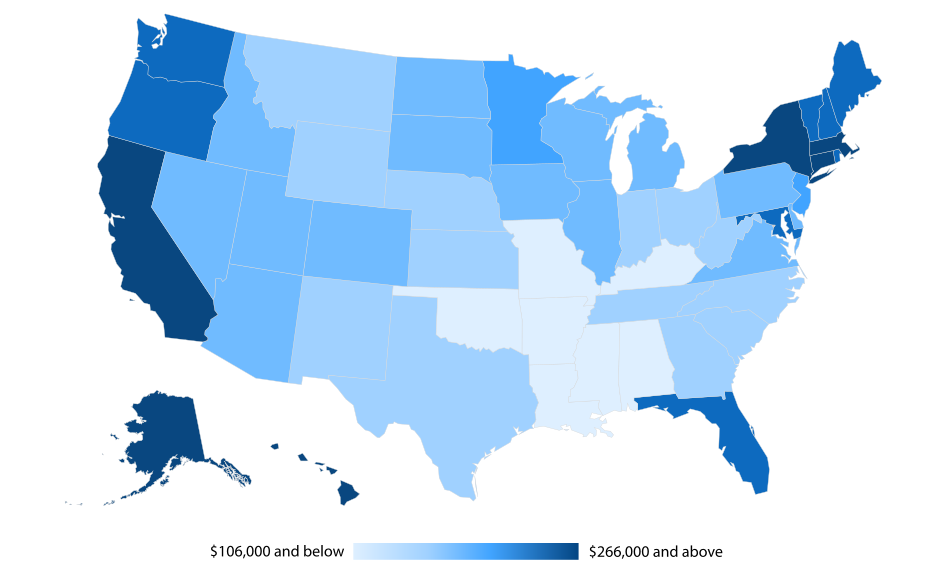
- Average mortality rates: Mortality rates differ widely by state. For example, in Hawaii, California, Washington, Florida, and New Hampshire individuals tend to live longer, whereas individuals in Mississippi, Alabama, West Virginia, Louisiana, and Kentucky tend to have lower life expectancies. Individuals with longer life expectancies are more likely to need LTC services, leading to higher overall LTC costs.
- Average morbidity levels: The likelihood of needing paid LTC and the duration of need also vary by state. For example, Florida, Alabama, and Louisiana are among the states with the highest estimated likelihood of needing paid LTC, whereas Colorado, Montana, and Hawaii are among the states with the lowest likelihood of needing paid LTC. Similarly, Montana, Arizona, and Oklahoma are among the states with the shortest projected duration of need, whereas Hawaii, Connecticut, and New York are among the states with the longest projected duration of need. States with a high likelihood of needing paid LTC and with a long projected duration of need have higher projected LTC costs.
- Cost of LTC services: Finally, the average daily cost of LTC services also varies by state. For example, Alaska, Connecticut, Massachusetts, Vermont, and Maryland have the highest average daily costs for LTC services. In contrast, Texas, Oklahoma, Louisiana, Alabama, and Mississippi have the lowest average daily LTC costs.
Figure 4 illustrates the variation in LTC Index by state, with dark blue indicating a higher LTC Index and light blue indicating a lower LTC Index.
Figure 4: LTC index by state
How can investing early affect the savings needed to cover long-term care costs?
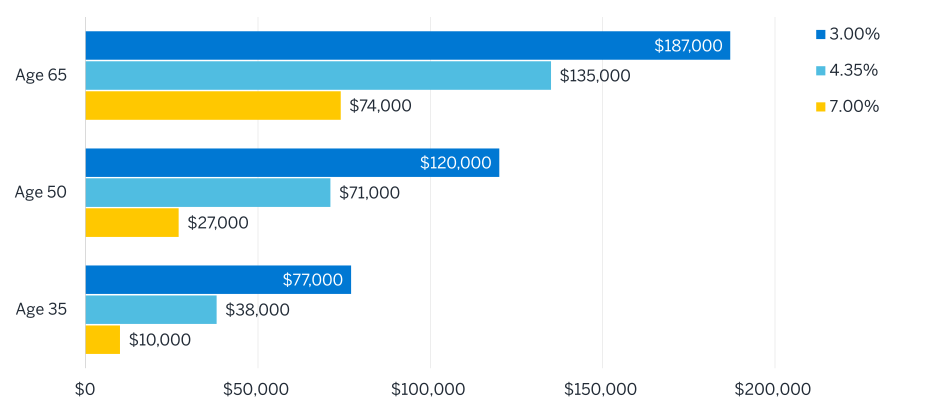
While LTC costs can vary based on a range of factors, such as health status, life expectancy, and geography, Figure 5 demonstrates how both the investment return rate and the age at which savings begin influence the initial amount required to cover future LTC expenses.
- Higher investment return rates reduce the amount needed to save today. The greater the investment return, the lower the initial savings required for future LTC costs. For example, our base modeling for the LTC Index assumes a 4.35% investment return rate. As Figure 5 shows, achieving a 7% return instead decreases the LTC Index from the average of $135,000 to $74,000.
- Starting to save earlier significantly lowers the initial savings required. The age at which an individual begins saving for a future LTC need can greatly affect the initial amount needed. For example, an individual who is 65 today and began saving at age 50 (15 years ago) with an annual investment return of 4.35% would have needed to set aside $71,000 at age 50, which would have grown to $135,000 by age 65 today.
Figure 5: Required savings to cover projected average LTC costs beyond age 65, by preretirement age
Sources and assumptions
The LTC Index is calculated using Milliman Integrate (formerly MG-ALFA), our best-in-class projection software. For simplicity, the LTC Index excludes costs for LTC services prior to age 65. We use Milliman’s LTC Guidelines as the main starting data source informing our projections. The Milliman LTC Guidelines reflect our research from data provided by 18 of the top 25 LTC insurers (based on lives in force), and informed by experience covering over 1.1 million claims and 82 million life years of exposure.
Following are summaries of the primary data sources leveraged for developing the LTC Index by key assumption.
- Morbidity: Assumptions for claim incidence, disabled life mortality, claim recovery, and transfers come from the Milliman LTC Guidelines. Since the Milliman LTC Guidelines come from insured data, we make adjustments to align our projections with a general overall population. We define eligibility for paid, formal long-term care as either needing assistance with two or more of the six activities of daily living, or having a severe cognitive impairment.
- Cost of care: Starting cost of care comes from a combination of sources, including the 2024 Genworth-CareScout Cost of Care Survey and Milliman LTC Guidelines. Long-term cost of care is projected into the future using long-term trends of approximately 3.5%.
- Mortality: We use a combination of sources to project healthy and disabled deaths, including the Milliman LTC Guidelines with adjustments for general population characteristics; 2024 Old-Age, Survivors, and Disability Insurance (OASDI, or Social Security) Trustees Report; and Centers for Disease Control and Prevention (CDC) age-adjusted mortality data by state.
- Investment returns: We assume a mix of 80% bonds and 20% equities. The investment returns were constructed from historical 10-year performance from the following benchmarks.
- Bonds: Bloomberg US Corporate Index, which tracks the investment-grade fixed-rate taxable corporate bond market
- Equities: S&P 500 Index, which is a market cap-weighted index that tracks the performance of 500 major publicly traded U.S. companies
Statement of limitations and qualifications
The authors of this article are actuaries for Milliman and members of the American Academy of Actuaries, and meet the qualification standards of the Academy to render the actuarial opinion contained herein. To the best of their knowledge and belief, this information is complete and accurate, and has been prepared in accordance with generally recognized and accepted actuarial principles and practices.
This information is intended to provide readers with a projection of LTC costs for individuals currently age 65. All estimates in this article are purely illustrative and are not intended to represent any information proprietary to any organization. This information may not be appropriate and should not be used for any other purposes.
All opinions expressed in this article are strictly the opinions of the authors. Milliman is an independent firm, and provides unbiased research and analysis on behalf of many clients. Milliman does not take any specific position on matters of public policy.